


I open most software vendor ROI calculators only to close them again in a couple of clicks.
I’m sharing this one because it doesn’t engage in false precision like most others.
I like that it gives you a high level ready reckoner of cost dynamics in an ERP rollout. It’s not enough to get your business case past the board, but it is enough to get you started, and thinking about it the right way.
If you have an ERP rollout on the pad and aren’t quite sure how to work through the ROI model, this is a good place to start

👉🏼 Tough situation got you spinning in circles? Send me your questions, and you might just see yourself in next week’s Mailbag. Submit anonymously using the button below:
Here’s what’s on the menu today:
Finding hidden connections in financial statements
Setting sales commission plans
Being a good cop, bad cop business partner
Now, let’s get into it.

YouAreTheMan from the US
What are cool and interesting connections between the P&L, BS and cash flow statements that you only know from your experience that isn’t taught in the classroom? For example, how does a decision from one side of the spectrum impact the other side of the spectrum? It would be awesome if you can use a global manufacturing company as an example.
For example, you’ve written about how the commercial decision to raise prices can potentially backfire: The customer leaves, volumes drop, standard O/H increases, and net absorption is unfavorable.

Super fun question, because the financial statements are full of these connections. And most of the interesting ones are behavioral, not accounting.
We're generally taught how financial statements work through the lens of accounting. Which means understanding how transactions flow through double-entry bookkeeping. Fixed assets go up, cash goes down, depreciation goes up, etc.
And that's important.
But it's nowhere near as important as understanding the commercial connections between the three statements.
Because everything in a business is connected, and the consequences of a decision rarely stop at the first financial metric they impact.
When businesses underperform, for example, they can get into a kind of doom spiral. Demand falls, so management puts prices up to recover margin. Which makes them less competitive, so volumes fall further. Fixed cost absorption deteriorates, but they can't get the overhead out quickly enough. Margins fall, bonuses get missed, good people start leaving, and operational performance suffers. Cash gets tight, the banks get nervous, and suddenly the cost of borrowing is going up too. And… well, you know how the story ends.
So let me give you a few examples of interesting connections that I think are frequently misunderstood or underestimated.
1. Pricing: The laziest lever
Pricing power is wonderful, but it's the laziest lever to pull. Every increase creates room for someone else to do it better or cheaper. It's like a drug that slowly makes businesses operationally lazy, until they can barely move. And then one day, they meet a fiercer competitor, enter a volume spiral (a bit like the one I discussed above) and can’t pull out. Using price as a lever is a strategic question that goes way beyond just ‘will the market take it’.
2. Procurement: Savings with a price
Procurement negotiates 5% off purchase prices in exchange for doubling minimum order quantities. Everyone claps, and banks the savings. Nobody thinks through the extra inventory, obsolescence risk, or reduced ability to react to changes in demand.
3. Complexity: Compound coordination costs
Every additional customer, product, and channel introduces complexity. Individually, each is easy to justify as contribution margin accretive. But collectively, that breadth demands a completely different organization, coordination effort, and working capital profile to support it.
4. Volatility: The capacity mismatch
Capacity isn't just a number. It's specific to a time, place, and product, and often fixed. Meanwhile… demand moves around day by day, product by product. You can have idle capacity and shortages simultaneously, hammering sales, margin, and working capital. AI infrastructure will face this challenge too, I think, once demand stops moving relentlessly up and to the right.
Honestly, I could give you dozens more, but these are some of my favorites.
As CFO, I think it's crucial to understand these unusual and sometimes counterintuitive connections across the business. Frequently, in the heat of microeconomic battles, it's in these details where markets are won and lost.
TLDR: The biggest financial consequences often hide in the second- and third-order effects of seemingly sensible business decisions.

Univ2217 from the UK
Someone at a dinner introduced me to your mailing list. So many relevant insights. What a revelation! Thank you for keeping it up so diligently.
I would value your thoughts on setting sales commissions schemes.
They seem to vary wildly in my experiences. In my last role in a narrow vertical SaaS business we made multiple acquisitions and saw different schemes for several effectively identical businesses. Commissions ranged from quota systems to a simple % of every deal, accelerators based on volumes or types of deals or even $ pipeline under management. And rates of commission which, as a % of salary, ranged from 5% to 400% for on-target performance, sometimes capped, sometimes uncapped. But it seemed to me high $ incentivised salespeople no more than low.
I'm now in an R&D-intensive product business in the defence sector. Salespeople are contractors rather than employees. Very few deals, but big dollar values. There's very little public information, but court cases (when things have gone wrong) suggest commission rates ranging from 0.3% to 15% on deals worth billions of dollars.
I want to build a scheme which incentivises but doesn't overpay. Where would you begin?

Well univ2217, all I can say is that you choose your dinner plans very well.
How to incentivize salespeople properly is a question as old as time. There is absolutely no one-size-fits-all answer, but within similar industry verticals and sales cycle types, there definitely are some established best practices.
I think SaaS has generally done a good job of establishing those practices within its specific vertical. Which makes sense, because that's where so much of the money and opportunity has been for salespeople over the last 15 years. You'd expect some sophistication.
But I think the first mistake people make is jumping straight to the commission percentage before thinking about what they're actually trying to incentivize.
So, I'd start by defining the characteristics of the sales model:
Sales cycle: Are you closing deals every day, or chasing a handful of enormous contracts over several years? (In your case it sounds like the latter).
Salesperson influence: How much of the sale is genuinely down to the individual at the margin, versus the product, brand, technical team, or existing customer relationship? Are you incentivizing real sales closers, or glorified order takers?
Economics: What is the contribution margin from the sale, not just the headline revenue? And how much risk sits in delivering it? How much risk is in the design of the sale itself?
Strategic priorities: Are you trying to win new customers, grow existing ones, improve margins, or sell particular products?
Predictability: How much of the outcome is within the salesperson's control? And how much depends on procurement cycles, customer budgets, or sheer luck?
Then you have the toolbox of mechanisms to build the scheme:
Commission basis: Revenue, gross profit, contribution margin, contract value, or some combination.
Targets and thresholds: Minimum performance before commission kicks in, quotas, and accelerators to inspire exceptional results.
Payment timing: On contract signature, delivery, revenue recognition, or cash collection. Or staged across several milestones.
Upside and limits: Uncapped earnings, commission caps, or declining rates on exceptionally large deals.
Quality controls: Margin floors, clawbacks, adjustments for cancellations, bad debts, or contracts that go badly wrong.
Fixed versus variable pay: Particularly important for long sales cycles, where people need to be rewarded for sustained effort before a deal closes.
So you can think of it like baking a cake. First, work out what kind of cake you need, then choose the ingredients and proportions.
Now, coming to your specific defense business.
With very few deals, enormous contract values, long sales cycles, and contractors rather than employees, I would be extremely cautious about simply agreeing to pay X% of every contract.
A salesperson could end up with a monster payday for a deal that was largely won by the technical team, or where the actual economic value to the company is a fraction of the headline contract value.
I'd be inclined to explore a structure with some combination of a modest retainer, clearly defined milestone payments, and a success fee linked to the economics of the contract.
And I would absolutely model the scheme against several real scenarios. A small deal, an enormous deal, a highly profitable deal, a marginal deal, and one that ultimately goes wrong.
One final point. I’ve never worked in defense contracting, but I would guess it comes with a whole extra layer of procurement and anti-bribery compliance. I'd get specialist legal advice before putting a contingent commission arrangement in place, particularly where government customers and third-party agents are involved.
Ultimately, you're trying to reward behavior changes that will have a marginal effect on the creation of economic value. If you keep that idea as your north star you won’t go far wrong.
TLDR: Design around the sales model first, then the commission mechanics. Reward genuine value creation, not just contract size.

PAR FP&A from Latin America
Hi, I really enjoyed your FP&A series. You mentioned how the CFO and CEO often take on the roles of "Chair" and "Agitator" during Monthly Business Reviews, similar to a good cop/bad cop dynamic. I'd love your advice on navigating a similar tension at the business unit level.
I report to the CFO but work deeply within a specific business unit on a daily basis. Because I'm so immersed in their daily operations, I sometimes find myself naturally defending their results rather than objectively challenging them. However, my CFO explicitly wants me to play the "bad cop" and challenge the commercial team and BU director during our MBRs.
How can an FP&A leader, like me, successfully balance these hats: being the collaborative partner who helps consolidate their numbers, while also being the objective agitator who challenges them during reviews?

This is the classic challenge for anyone in a deep business partnering role. You need to build and maintain trust with the business you're supporting, but you also need to do the same with your own finance leadership.
Get it right, and you can be influential on both sides, and even the bridge that makes the relationship work. Get it wrong, and you'll quickly find yourself orphaned in the business.
Very few business partners are actually good at this. They tend to lean too far one way or the other. It's easy to do, and it's why good business partnering is so difficult.
But you do have to figure this out, because I think you've actually got the answer in your own question: "My CFO explicitly wants me to play bad cop during the MBRs."
Well, there you go!
The question isn't really what you need to do. It's how you do it without losing the trust and support of the business.
That depends a little on the dynamics of your team, but I'd be inclined to sit down with your BU director and have an honest conversation.
Something like:
"Look, my CFO has made it clear that they expect me to challenge the business directly during these meetings. And frankly, I think it's an important part of my role.
"But I want you to understand that I'm not trying to catch anyone out or make anyone look bad. I'm trying to help drive better performance.
"And if I'm not asking the difficult questions, chances are the CFO will be. Which will probably be a lot less comfortable for everyone!
"So how can we work together to make sure we get the dynamics right?"
Then agree a routine.
You should be challenging the BU director and their team well before the MBR. Testing their assumptions, probing the numbers, understanding where things are going wrong, and making sure they have properly thought through their responses.
That doesn't mean rehearsing a performance where you throw a few softball questions and they knock them out of the park.
It means no surprises, but no free passes either.
When you get into the MBR, you can challenge them robustly, knowing you've already done the work together. And the business can respond confidently, knowing you're asking questions in the interests of better performance rather than trying to score points.
Over time, the best outcome is that your business leaders actually welcome your challenge, because they know it makes them better.
That's when you know you've cracked business partnering.
TLDR: Agree the rules of engagement with your BU director. Challenge hard, prepare together, and avoid nasty surprises.


Apple is making an interesting bet here, investing heavily in AI without splashing billions on data centers. It’s a good example of a bold ‘beneath the MFCF line’ capital allocation decision, trading CapEx for R&D.
Binance’s CFO change has apparently been planned for months, but the timing couldn’t be much worse, with the incoming CFO inheriting a weapons-grade compliance and cyber security headache.
Interesting career bet as one of Zuck’s top dogs bolts for an AI start up CFO role.

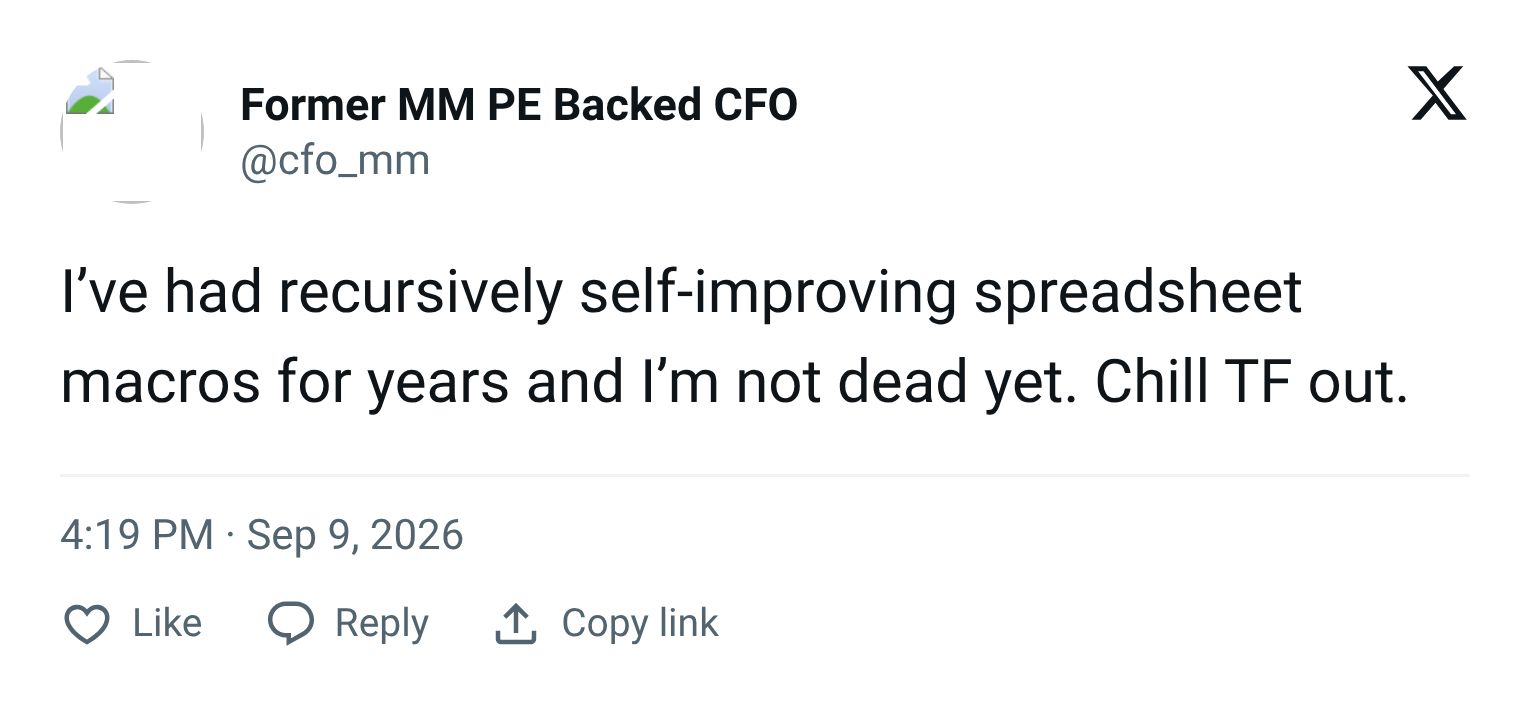
ICYMI, here are some of my favorite finance/business social media posts from this week.


If you’re looking to sponsor CFO Secrets Newsletter, fill out this form, and we’ll be in touch.
If you enjoyed today’s content, don’t forget to subscribe.
You can help make sure this newsletter always stays free simply by spreading the word. And when you share CFO Secrets with your finance friends, you’ll earn rewards, including a 50-page PDF guide on what it takes to be a great CFO. Start sharing your unique referral code today: {{rp_refer_url}}
Last weekend’s Playbook kicked off a new series on Treasury.
Last week’s Boardroom Brief looked at what to do when you are the youngest one in the boardroom.


Disclaimer: I am not your accountant, tax advisor, lawyer, CFO, director, or friend. Well, maybe I’m your friend, but I am not any of those other things. Everything I publish represents my opinions only, not advice. Running the finances for a company is serious business, and you should take the proper advice you need

